Tuesday, November 1, 2011

2010 Mercedes-Benz GLK 350 4MATIC

Mercedes-Benz released official pictures and information of the all-new Mercedes-Benz GLK-Class sport utility vehicle. The versatile SUV will debut at Auto China in Beijing on Sunday, April 20, and make its U.S. dealer showroom debut in January 2009 as a 2010 model.
Powered by a 268-horsepower, 3.5-liter V6 engine the 2010MY Mercedes-Benz GLK 350 will form the basis of the U.S. lineup, and will be offered in both 4MATIC and two-wheel-drive versions, riding on standard 19-inch 10-spoke wheels with 235/50 tires. The GLK features a 108.5-inch wheelbase and boasts unique design language which sets it apart from the rest of the highly successful Mercedes-Benz family of SUVs that includes the M-Class (which spurred the trend toward more car-like SUVs), the larger GL-Class, the crossover R-Class and the iconic G-Class.
Showcasing bold exterior design, generous cargo capacity and available 4MATIC all-wheel-drive, the GLK 350 combines the perfect balance of styling, versatility and performance. The 2010 Mercedes-Benz GLK-Class will be produced exclusively at the Mercedes-Benz plant in Bremen, Germany.

Aggressive Styling and a Unique Personality
With its poised, confident presence, the GLK-Class leaves no doubt about its intent to conquer the compact premium SUV segment. In sharp contrast to the relatively soft forms of other similar-sized vehicles, the striking, angular profile of the GLK sets it apart from the competition. From its steeply-raked windshield to the integrated rear spoiler on its tightly styled roof section, the bullish shape of the new Mercedes GLK suggests power and agility, and echoes the G-Class -- the iconic pioneer of the Mercedes-Benz SUV family.
 Mercedes-Benz Design Chief Prof. Peter Pfeiffer adds: "With the G-Class we created a style icon that has been a benchmark in SUV design for the past 30 years. Combining this bold concept with the latest Mercedes-Benz design idiom makes the GLK a vehicle of genuine character."

Beautiful proportions (length 178.3 inches, width 72.4 inches, height 66.9 inches) and styling combine classic angular shapes together with the distinctive design features found in contemporary Mercedes-Benz passenger cars. Taut lines and large, expansive surfaces mix with the traditional characteristics of a proper off-road vehicle, such as short overhangs, an upright front end, slim roof pillars, and a steeply raked windshield. Generous angles of approach and departure combined with impressive ground clearance allow the GLK to handle light off-roading with ease. On-road, the clear layout of the exterior and good all-around visibility, combined with a commanding seating position, enhance everyday practicality and relaxed driving, even in dense city traffic.

A Luxurious, Feature-Rich Interior
The GLK boasts a long list of standard equipment, including details not typically found in this vehicle class. Inside, a two-zone automatic climate control system, adjustable steering column, front seats with electrically adjustable height and backrest angle (including seat inclination adjustment) and manual lumbar support with two-way adjustment for the driver's seat are all standard on the GLK. Standard integrated Bluetooth interface for mobile phones, a microphone for the hands-free system and a central 5-inch color display round out the list of interior appointments.
The 2010 Mercedes-Benz GLK features all the impressive design and safety technology found in other Mercedes-Benz models, including standard front and side air bags as well as window air bags. Among its many comfort and convenience features is an available rear-seat entertainment system featuring two eight-inch screens, wireless headphones and an integrated dual-source DVD player.

The distinctive looks of the GLK exterior are seamlessly continued inside, with luxurious materials and precise detailing. The taught, sculpted lines of the dashboard dominate the interior, visually extending into the door panels to lend additional width to the generously dimensioned cockpit. Luxurious Sienna Pine wood with chrome trim highlights the dashboard and door panels at the front and rear, while the upper section of the encompasses the instrument cluster and the standard 5-inch color display. The driver's armrest features integrated cupholders and the standard controller for the audio functions and the optional COMAND multimedia system are located in ergonomically ideal positions between the front seats. Control of the individual menus is intuitive, following the familiar and well-proven layout used in the current C-Class and S-Class models. Additional shortcut buttons provide direct access to the most important main functions. Front and rear headroom figures are 39.8 inches and 39.7 inches respectively, while the cargo area boasts 23.3 cubic feet of storage. Cargo capacity balloons to 54.7 cubic feet when the 1/3:2/3-split rear seats are folded forwards.

A Wealth of Optional Equipment for the GLK buyer
Contributing to the versatility of the new SUV, five option packages as well as nine stand-alone options are planned for the 2010 Mercedes-Benz GLK 350. The popular Premium 1 package offers GLK buyers a spacious Panorama Sunroof, SIRIUS satellite radio and a power liftgate. Customers seeking even more luxury can opt for the Premium 2 package, which adds Bi-Xenon headlamps with adaptive lighting and headlamp washing system, rain sensing windshield wipers, memory settings for the driver's seat, and much more. The Multimedia Package (which debuted on the new C-Class) adds COMAND with hard-drive Navigation as well as a rear-view back-up camera. Exterior options include an Appearance Package offering larger 20-inch 7-spoke wheels and Aluminum roof rails and, for the interior, an Upholstery Package adds interior lighting, a full leather interior and burl walnut trim.

Available 4MATIC All-Wheel-Drive System
The optional all-wheel-drive powertrain at the heart of the Mercedes-Benz GLK 350 4MATIC is one of the most capable systems on the market. The dynamic ESP®, ASR and 4ETS driving systems work in concert to ensure top-notch longitudinal and lateral control and superb handling stability both on and off-road. Thanks to a compact, longitudinally designed engine, transmission and transfer case arrangement, the system offers various advantages over its counterparts equipped with a transversely installed drive unit. Estimated 23 mpg highway fuel consumption is on a par with comparable rear-wheel vehicles, while vibration and noise levels rival those of luxury models.
The 45:55 torque distribution between the front and rear axle - along with the ESP®, ASR and 4ETS dynamic handling control systems - guarantees effortless and exceptional performance. Loss of traction on snow or ice is compensated for by the newly developed multi-disc clutch in the center differential, which provides a basic partial locking torque between the front and rear axle. This arrangement produces a significant increase in traction while maintaining directional stability.

Agility Control Suspension
The sophisticated Agility Control suspension on the new Mercedes GLK-Class helps resolve a common paradox facing the SUV segment - how to create a vehicle that combines agile on-road comfort with off-road capability. For sporty, responsive handling, the suspension and, above all, the shock absorbers need to provide a certain firmness however, this may compromise comfort and limits off-road performance. If the vehicle is setup with softer dampers, dynamic handling naturally suffers. Thanks to "amplitude-dependent damping" the suspension can adjust to perform in either driving conditions. During normal driving on moderately contoured roads or slow off-road manoeuvres, the system responds softly, enhancing both the occupants' comfort and the vehicle's off-road capability. During more spirited driving or when performing abrupt evasive maneuvers, the dampers adjust to a harder setting ensuring optimum handling stability. Additionally, speed-sensitive power steering supports the driver with a precise balance of high-speed road feel and low speed maneuverability. Maximum power assistance is available during parking and off-road driving, while at higher speeds, the assistance is reduced in favor of greater handling stability.
In addition to a tire pressure warning system, the tried-and-tested Electronic Stability Program (ESP®) for the GLK incorporates a vehicle/trailer stabilization function, which helps maintain control while towing a trailer by applying the individual wheel brakes as required. The GLK offers a maximum tow rating of 3,500 lbs.

Complete Safety Package for Maximum Occupant Protection
In combination with the front and rear deformation zones, the GLK's high-strength passenger cell provides a highly efficient foundation for the occupant protection systems, which include:
  • Adaptive, two-stage airbags for the driver and front passenger
  • Front side-impact airbags
  • Windowbags across both seat rows from the A-pillar to the C-pillar
  • Active head restraints for the driver and front passenger
  • Crash-optimized pedal system
  • 3-point seat belts for all five seats
  • Belt tensioner and adaptive belt-force limiter for the driver and front passenger, belt tensioner and single-stage belt-force limiter for the outer rear seats
  • ISOFIX child seat attachments
  • Belt height adjuster for the driver and front passenger
  • Belt status indicator for the rear passengers in the instrument cluster
Mercedes remains true to the philosophy that the best accidents are the ones that are avoided entirely. With this in mind, standard equipment for all GLK models includes Brake Assist (BAS), which shortens the braking distance significantly -- especially during panic braking -- to help prevent accidents or at the very least mitigate their consequences. The front section incorporates precisely defined crumple space between the body and the major assemblies beneath, allowing the hood to yield considerably if hit by a pedestrian, cyclist or motorcyclist. Together with the specially designed front bumpers and the softer foam of the integrated bumper impact absorbers, these measures afford pedestrians a high degree of protection.

Proven V6 Powerplant
The new sport utility is destined to be one of the most fuel-efficient Mercedes-Benz vehicles ever. Smaller and lighter than its well-known SUV siblings, the GLK features a fuel-sipping 3.5-liter V6 engine, a sophisticated seven-speed automatic transmission and available 4MATIC full-time four-wheel-drive. All of these components combine to give the Mercedes-Benz GLK 350 an impressive 0-60 time of just 6.5 seconds (estimated) while achieving an 23 mpg (estimated) on the highway.
Both the Mercedes-Benz GLK 350 and GLK 350 4MATIC are matched with a seven-speed automatic transmission as standard. Low overall weight (estimated 4,036 lb. curb weight) and the exceptional aerodynamics for a vehicle of this design (cd figure 0.35) further contribute to the exceptional performance and low fuel consumption.
Much as the latest C-Class sedan has brought a new level of sporty driving and ride comfort to the sedan world, the new Mercedes GLK brings a new combination of agility and comfort to the SUV market. The GLK also broadens and extends the Mercedes-Benz sport utility line with cutting-edge engine and four-wheel-drive technology packaged in a stylish vehicle that's the perfect size for today's busy family.

The Widest Range of SUVs
Mercedes-Benz offers the widest range of SUVs in the premium segment, the GLK being the brand's fifth model in the series. In response to customers' wishes, the company's Family of SUV's has grown to include the R-Class, M-Class, GL-Class and G‑Class. The new Mercedes GLK is the latest addition to this successful line-up.


2010 Mercedes-Benz ML450 Hybrid

In the search for the optimum hybrid system for the Mercedes-Benz ML450 Hybrid, the engineers were already sure of one thing right from the concept phase: a Mercedes-Benz SUV with a hybrid drive would have to share the same typical brand attributes as any other Mercedes vehicle. Essential elements such as the greatest possible active and passive safety, optimum ride comfort and ease of operation, uncompromising reliability over a long period and high-quality workmanship with select materials would have to be on a par with a comparable, conventionally powered standard-production vehicle. And all combined with the greatest possible efficiency. At the same time, the drive system should be testimony to the company's innovative strength and cutting-edge technology. These objectives demanded a complete development cycle - the kind of process any new model family developed from scratch would undergo. Until the Mercedes-Benz ML450 Hybrid reached series-production maturity, the engineers and technicians clocked up a total of four million kilometres, taking in some of the world's most extreme climatic conditions to prove the system's reliability, be it in the sub-zero Arctic circle, the searing heat of arid desert regions or in the sweltering, humid temperatures of the tropics. The work was supplemented by an extensive test-rig programme and detailed simulations as part of the "Digital Prototype". An important aim during development was to optimally match the various subsystems within the powertrain. System matching enables the various drive modes to be easily used while the customer is driving.

The two-mode hybrid technology in the Mercedes-Benz ML450 Hybrid, whose drive architecture supports purely electric operation and purely combustion engine operation or any combination of the two, takes its lead from the fundamental work undertaken by the "Global Hybrid Cooperation". This group brought together research and development work undertaken by the companies Daimler AG, BMW Group, General Motors and Chrysler.
Superior technology: two-mode hybrid for the most efficient drive system
Thanks to two-mode hybrid technology the Mercedes-Benz ML450 Hybrid boasts tangible benefits: its performance figures are on a par with a conventional eight-cylinder SUV with permanent all-wheel drive while fuel consumption and emissions have been reduced by up to 60%. The vehicle designed specifically for the US market delivers 'city' fuel consumption of 21 mpg and 'highway' consumption of 24 mpg, making it the most efficient vehicle in its segment. With its SULEV (Super Ultra Low Emission Vehicle) classification, the SUV meets the most stringent emissions standard for vehicles with a combustion engine currently applicable in the US. At the same time, the Mercedes-Benz ML450 Hybrid with a system output of 250 kW (340 hp) and a combined torque of 517 newton metres guarantees a superlative driving experience combined with an enhanced level of ride comfort. The driver can concentrate fully on the traffic and enjoy the Mercedes-Benz ML450 Hybrid driving experience without having to select additional functions as the drive management system is fully automatic. The functionality of the 4MATIC permanent all-wheel drive system is also fully retained.
At the heart of the two-mode hybrid drive is the transmission unit with two compact electric motors, three planetary gear sets and four clutches. This configuration enables the power to be split into an electrical and a mechanical path. Conventional one-mode hybrid systems tend not to have mechanical ratios. As such, this kind of system transfers the bulk of the power via the electrical path with high electrical output and hence lower efficiency. It works efficiently principally at lower loads and speeds. If power also needs to be transferred at higher loads and speeds, an accordingly larger electric motor would be required. Having to power and find space for this engine would only be possible at the expense of efficiency. In response to increasing engine loads and higher speeds, two-mode technology, by contrast, variably shifts the power transfer from the electrical path to the mechanical drive path. As a result, the system is much more efficient in all situations, both in inner-city stop-and-go traffic as well as on fast motorway journeys, while also enabling smaller electric motors to be used. The efficiency boost - both in urban traffic as well as on motorway journeys - is therefore where "two-mode" technology gets its name from.
The four clutches are used to distribute the driving force generated by the electric motor and combustion engine via four fixed ratios and two electric variable ratios to all four wheels on the 4MATIC permanent all-wheel-drive system, depending on the driving situation. Various strategies ensure the best possible fuel consumption and performance, depending on the traffic situation or the driver's requirements:
  • When moving off or at low speed up to the second fixed gear, the Mercedes-Benz ML450 Hybrid operates in ECVT 1 mode (Electric Continuously Variable Transmission), delivering a very comfortable, smooth ride.
  • At higher speed from the second fixed ratio, ECVT 2 mode is used. Depending on the optimum operation point, a combined or continuously variable mode is selected.
  • In the first and third fixed gear both electric motors work synchronously, providing either additional energy for acceleration (boost) or storing the braking and coasting energy (recuperation).
  • In the second and fourth fixed gear, one electric motor is switched off to improve efficiency. The second electric motor is used for the booster function and recuperation.
The two compact electric motors boast a high power density and are fully integrated into the transmission housing. The limited installation space means the two electric motors have to be configured differently. The first electric motor - positioned nearer to the combustion engine - develops 62 kW (85 hp) and 235 newton metres of torque and has been designed with power output and minimal losses firmly in mind. The electric motor placed at the end of the transmission develops 60 kW (82 hp) and 260 newton metres and is thus the ideal solution for moving off solely under electric power and providing the booster function.
Compact 288-volt battery with high power density
The electrical energy in the Mercedes-Benz ML450 Hybrid is stored in a compact, liquid-cooled high-voltage nickel-metal hydride battery.
Battery data at a glance:
  • Type: Liquid-cooled high-voltage nickel-metal hydride battery
  • Mounting location: Vehicle rear
  • Weight: 83 kg
  • Modules / cells: 24 / 240
  • Electrical output: 45 kW
  • Capacity: 2.4 kWh
  • Voltage: 288 V
A battery management function monitors and controls the various charge flows during electric motoring, boost or recuperation to ensure a stable charge state. The entire high-voltage onboard network complies with the most stringent safety standards.
Sophisticated management system computes the most fuel-efficient operating mode in real time
Operation of the two external rotor magneto motors and the management of the entire high-voltage onboard network requires complex control electronics housed in the engine compartment of the Mercedes-Benz ML450 Hybrid. Waste heat from the electronics is dissipated via a separate cooling circuit to increase efficiency. An integrated Auxiliary Power Module enables power to be exchanged between the 288-volt battery and the 12-volt onboard network.
A powerful computer controls the hybrid system with up to 50 million computing operations a second. The electronic control unit calculates the most efficient operating mode 160 times a second, thus ensuring the lowest possible fuel consumption. The management system also supports new functions and comfort/convenience features:
  • The transmission's coordinated shift strategies ensure judder-free manoeuvring
  • "Chill down" mode enables the battery to recover during overload or high temperatures
  • An adaptive drive mode learns the driving style of the driver or the particular route profile to optimise the agility of the drive mode
  • The "Power Launch Control" supports optimum acceleration in boost mode
  • The "Traffic Jam" feature enables the vehicle to be driven entirely under electric power in stop-and-go traffic even with a low battery charge status
Consumption-optimised Atkinson V6 engine
The modified 3.5-litre V6 petrol engine has been optimised in accordance with the Atkinson process, delivering substantially better fuel consumption and emissions figures with an output of 205 kW (279 hp) and a maximum torque of 350 newton metres. The development engineers utilised some of the benefits of the Atkinson principle whereby the expansion phase is longer than the compression phase. The intake valve is kept open slightly longer between the intake and compression phases, which improves the engine's thermal efficiency while reducing the specific fuel consumption and untreated emissions. This process is not used with conventionally powered vehicles because Atkinson engines - apart from the lower fuel consumption and emissions - tend to deliver lower torque at lower revs and thus inferior response particularly at low engine speeds. On the Mercedes-Benz ML450 Hybrid this drawback is more than offset through the use of the electric motors when moving off normally, accelerating or using the booster function. The M-Class thus offers superb responsiveness and agility.
Compared with the conventional 3.5-litre V6 petrol engine, the Atkinson version features a modified cylinder head, pistons and camshaft. The camshaft timing has also been modified. The newly developed regulated oil pump adjusts the flow rate to the engine's actual requirements, thus minimising the necessary delivery rate and helping reduce fuel consumption and emissions. Since the alternator and starter functions are integrated in the two electric motors, these two components, which are now surplus to requirements, no longer need to be connected up to the belt drive on the combustion engine. The air conditioning compressor and the steering servo pump are another two components that do not need to be powered via the belt drive. These are driven electrically on the Mercedes-Benz ML450 Hybrid and can be run independently of the combustion engine.
Operating strategies of the two-mode hybrid drive
The Mercedes-Benz ML450 Hybrid offers the full range of extra functions offered by a hybrid drive. These include variable hybrid mode for city and motorway driving, silent, purely electric moving off and motoring, the "booster function" for fast acceleration, recuperation and the start/stop function. These functions are activated depending on the operating state and traffic situation:
  • While at a standstill, the combustion engine is switched off. The air conditioning and power steering functions are fully retained thanks to the electric drive of the air conditioning compressor and the steering servo pump.
  • Manoeuvring, for instance when parking, only uses the electric drive.
  • If the driver presses the accelerator from a standstill, the Mercedes-Benz ML450 Hybrid moves off solely using electric power. If the accelerator is pressed rapidly, the management system recognises the need for increased acceleration, activates the combustion engine which it backs up with additional torque from the electric motor (booster effect). This noticeably increases the vehicle's agility without having to use the kickdown feature.
  • When cruising, the operation point is shifted toward lower specific fuel consumption figures to increase the efficiency of the V6 engine while in turn also increasing efficiency particularly under partial loads.
  • Recuperation, the conversion of braking energy into electric power and subsequent storage starts immediately the vehicle is in overrun mode or during normal braking manoeuvres. The service brake is also activated during heavy braking. The Mercedes-Benz ML450 Hybrid can match where necessary the kind of good maximum deceleration you will find on a conventionally powered M-Class with the same superb handling.
  • The start/stop function deactivates the V6 engine as soon as it is not needed, say when rolling up to a red traffic light. As soon as the driver presses the accelerator, the ML moves off using electric power and then starts the combustion engine.
  • The Silent Start enables the vehicle to be started without creating any noise.
Info display indicates current operating state
The Mercedes-Benz ML450 Hybrid driving experience offers an impressive mix of high agility and balanced ride comfort under all operating conditions. A specially designed display concept enables the driver to keep track of the particular drive mode. The COMAND system display can be used to either display the current energy flow between the high-voltage battery, combustion engine and electric motors including the percentage charge state of the battery, or a fuel consumption and recuperation energy graphic. The battery charge state can also be called up in the instrument cluster. The conventional rev counter is replaced by a display which illustrates the combined drive system and recuperation output at a given moment.
The choice is yours: Economy or Sport mode
To ensure you can experience the extraordinary agility of the Mercedes-Benz ML450 Hybrid even more emphatically, apart from Economy mode, the model comes with a Sport mode, which is activated using the "E/S" button in the centre console. This operating mode provides the handling of a conventional automatic transmission with eight fixed ratios and very short shift times. The response is even more spontaneous thanks to the decidedly sporty engine and transmission control unit and the direct through-drive in the powertrain. Sport mode also recognises the driving characteristics of the driver or the particular road profile and adapts the system management function accordingly.
Classic benefits of the M-Class remain unchanged
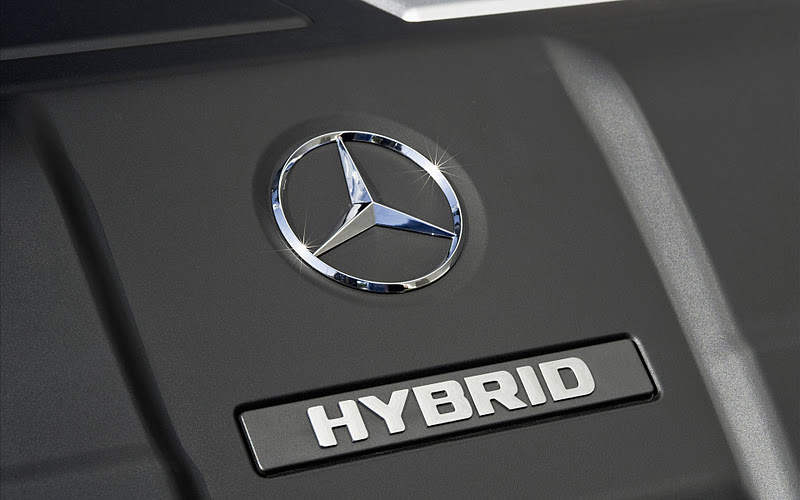
The Mercedes-Benz M-Class models rank among the most successful premium SUVs and offer the greatest possible active and passive safety, optimum ride comfort and ease of operation, uncompromising reliability over a long period and high-quality workmanship with select materials. These attributes naturally also apply to the Mercedes-Benz ML450 Hybrid, which in these respects offers performance on a par with the conventionally powered variants. The hybrid version meets the same crash requirements and offers outstanding active safety thanks to the dynamic handling control systems ESP®, ABS or BAS and the 4MATIC permanent all-wheel-drive system. The hybrid technology has been integrated perfectly, without taking up any additional installation space which would compromise comfort or practicality. The space in the passenger compartment is unchanged; the boot capacity is as large as ever. The only external clues on the Mercedes-Benz ML450 Hybrid are the redesigned bonnet, the BlueEFFICIENCY label on the wings and the HYBRID lettering on the rear.
The Mercedes-Benz ML450 Hybrid is produced at the Mercedes-Benz plant in Tuscaloosa, Alabama, in the United States.
Technical data (US figures)
  • Combustion engine
    • Type: Atkinson-style petrol engine
    • Number of cylinders/arrangement: V6
    • Displacement: 3498cc
    • Valves per cylinder / valve control system: 4 / continuously variable
    • Rated output: 279 hp (205 kW) @ 6000 rpm
    • Max. torque: 350 Nm (259ft-lbs) @ 3000-5500 rpm
  • Electric motors
    • Rated output, electric motor 1: 84 hp (62 kW)
    • Rated output, electric motor 2: 82 hp (60 kW)
    • Max. torque, electric motor 1: 235 Nm (174 ft-lbs)
    • Max. torque, electric motor 2: 260 Nm (192 ft-lbs)
  • Combined system output
    • Rated output: 340 hp (250 kW)
    • Max. torque: 517 Nm (383 ft-lbs)
  • Fuel consumption FE Label mpg
    • City: 21 mpg
    • Highway: 24 mpg
    • Combined: 22 mpg
    • Tank capacity: 90 l (23.8 gal)
    • Theor. range: 840 km (520 mls)
  • Emissions standard: SULEV
  • Performance
    • 0-60 mph: 7.8 s
    • ¼ mile: 15.8 s
    • Top speed: 131 mph

2010 Mercedes-Benz S-Class


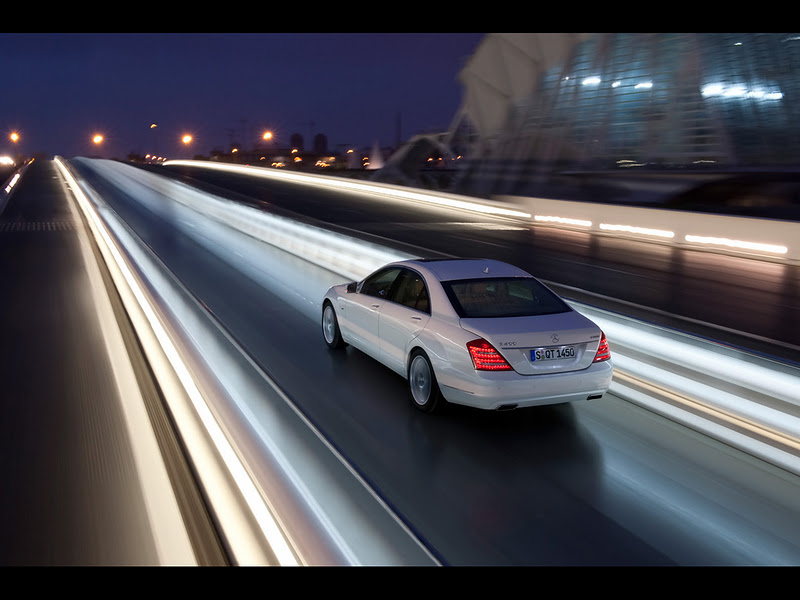
Four years after the market launch of the W221 model series, Mercedes-Benz is presenting the 2010 Mercedes-Benz S-Class. Trailblazing innovations in the areas of comfort and drive engineering combined with state-of-the-art technology for enhanced safety consolidate the Mercedes-Benz flagship's position as the brand's innovation driver and underscore its pioneering role in the automotive industry as a whole. The technology highlights include the world's first standard production hybrid drive with a lithium-ion battery in the S400 HYBRID, which makes the top-of-the-line Mercedes-Benz model the most economical petrol-engine luxury saloon. The fuel consumption of 7.9 litres per 100 kilometres corresponds to carbon dioxide emissions of just 186 grams per kilometre.
The engine range further includes eight modern petrol and diesel engines that require up to seven per cent less fuel. With an average fuel consumption of 7.6 litres of diesel, the S350 BlueEFFICIENCY is one of the most efficient models in the luxury segment. The Mercedes-Benz S-Class's traditionally exemplary standard of safety is further enhanced by a unique combination of innovative camera- and radar-based driver assistance systems which turn the luxury saloon into an "intelligent" partner on the road. These systems include Adaptive Highbeam Assist, Lane Keeping Assist, Speed Limit Assist and the advanced Night View Assist PLUS facility. Other innovations are the ATTENTION ASSIST drowsiness detection function and automatic crosswind stabilisation.
With 270,000 units sold since its market launch in autumn 2005, the W221-series Mercedes-Benz S-Class is the world's most successful luxury saloon, and seamlessly continues the success story of the flagship model in the Mercedes line-up. Since 1951, when the model 220 began the lineage of the Mercedes-Benz S-Class, Mercedes-Benz has delivered around 3.3 million passenger cars from this model series to customers.

Mercedes-Benz S400 Hybrid: the world's most economical petrol-engined luxury saloon.
The 2010 Mercedes-Benz S-Class once again represents the cutting edge of automotive development. Mercedes-Benz's technology leadership is demonstrated by the new S400 Hybrid, which is the first production vehicle in the world to feature a hybrid drive with a lithium-ion battery. "The S400 Hybrid is an important milestone on the way to emission-free mobility," notes Dr Dieter Zetsche, CEO of Daimler AG and head of Mercedes-Benz Cars. "Our first series production hybrid car exemplifies Mercedes-Benz's long-standing development strategy geared towards sustainability, with its clearly defined aim of producing economical and environment-friendly premium cars without compromising on safety, comfort and superior performance."
The first hybrid drive in a series production car from Mercedes-Benz makes this Mercedes-Benz S-Class model the most economical petrol-engined luxury saloon. The fuel consumption of 7.9 litres per 100 kilometres corresponds to carbon dioxide emissions of just 186 grams per kilometre. This is the lowest level worldwide in this vehicle segment, confirming the new S400 Hybrid as the "CO2 champion of the luxury class".
The new Mercedes-Benz S400 Hybrid is the first car to be designed on the basis of the highly intelligent modular concept developed by Mercedes-Benz to give its customers the best hybrid solution for their requirements. The S400 Hybrid, which assumes the role of technological trendsetter within this concept, offers all the essential features from the word go:
  • a compact yet powerful electric motor
  • the appurtenant power electronics
  • a modern high-capacity lithium-ion storage battery.
The compact hybrid module combines the hybrid functions of an automatic start-stop system and energy recuperation. In all, this means that the S400 Hybrid sets a new standard in its class, making it the world's most economical luxury saloon with a petrol engine.
The excellent fuel consumption and the low CO2 emissions of the S400 Hybrid are accompanied by truly superior performance potential: the modified 3.5 litre petrol engine generates 205 kW/279 hp, while the electric motor produces 15 kW/20 hp and starting torque of 160 Nm.
The Mercedes-Benz S400 Hybrid is based on the S350, and features an extensively modified drive train. This encompasses a further development of the 3.5-litre V6 petrol engine, an additional magneto-electric motor, the 7G-TRONIC seven-speed automatic transmission specially configured for the hybrid module, the necessary power and control electronics, the voltage converter and the high-voltage lithium-ion battery.
During braking the electric motor acts as a generator, and is able to recover kinetic energy by a process known as recuperation. During this process the electric motor works together sensitively with the engine brake of the internal combustion engine and the conventional wheel brakes. The recuperated energy is stored by a compact but efficient lithium-ion battery in the engine compartment, and retrieved when required. Major advantages over conventional nickel/metal hydride batteries include a higher energy density and greater electrical efficiency combined with more compact dimensions and a low battery weight. Thanks to space-saving installation in the engine compartment, the boot capacity and generous interior dimensions remain unchanged. The hybrid module also has a convenient start-stop function.
Efficient diesel and petrol engines
Apart from the trailblazing hybrid of the Mercedes-Benz S400 Hybrid, the range of engines for the 2010 Mercedes-Benz S-Class comprises eight other powerful units: two diesel variants and six petrol engines with six, eight and twelve cylinders. Detailed fine-tuning of these engines has been supplemented with addition fuel economy measures as part of the BlueEFFICIENCY package. These include aerodynamic optimisation, demand-controlled fuel pumps and the fuel-efficient gearshift programme for the standard 7G-TRONIC automatic transmission. These measures have enabled Mercedes-Benz developers to reduce fuel consumption and CO2 emissions by up to seven percent compared to the preceding models. By means of additional well-aimed aerodynamic measures, the Mercedes-Benz engineers have also managed to reduce wind noise, thus further enhancing the standard of ride comfort.
With diesel fuel consumption of 7.6 litres per 100 kilometres and CO2 emissions of 199-201 grams per kilometre, the S350 CDI BlueEFFICIENCY (173 kW/ 235 hp) likewise boasts outstanding figures for the luxury class. Mercedes-Benz achieves this exemplary efficiency with a tailor-made BlueEFFICIENCY package, which also includes closed underbody panelling and decoupling of the 7G‑TRONIC automatic transmission at standstill.
The 3.0 litre diesel engine is also used in the S350 CDI 4MATIC. The second diesel variant is the eight-cylinder S 450 CDI(235 kW/320 hp) with a displacement of 4.0 litres. The range of petrol engines comprises the six-cylinder S350/ S350 4MATIC (200 kW/272 hp) with a displacement of 3.5 litres and the two eight-cylinder units in the S 450/S 450 4MATIC (250 kW/340 hp; displacement 4.7 litres) and S 500/S 500 4MATIC (285 kW/388 hp; displacement 5.5 litres). The flagship model is still the S600 with the 380 kW/517 hp twelve-cylinder biturbo unit (displacement 5.5 litres), which accelerates the luxury saloon to 100 km/h in 4.6 seconds. The Mercedes-AMG high-performance contributions to the range are the S 63 AMG with its 386 kW/525 hp V8 engine (displacement 6.2 litres) and the S 65 AMGwith a 450 kW/612 hp twelve-cylinder engine (displacement 6.0 litres).
Unique combination of driver assistance systems
A world-first combination of state-of-the-art assistance and protection systems is available for the 2010 Mercedes-Benz S-Class. Many of these systems are also available in the new Mercedes-Benz E-Class, which has been on the market since the end of March 2009. The new assistance systems turn the models of the E-Class and S-Class into "intelligent" partners for their drivers. The car is able to "see", "feel", to respond "instinctively" to detected dangers and to act "on its own initiative" in order to avoid accidents or to reduce the severity of accidents.
"Similarly to the established Mercedes inventions ABS, ESP®, Brake Assist and PRE-SAFE®, the new assistance systems are also geared to the realities of how accidents occur and what consequences they entail," observes Dr. Thomas Weber, member of the board of management at Daimler AG and responsible for corporate research and the development of Mercedes-Benz Cars. "The aim in developing these systems was to prevent particularly common and serious collisions. With this concept, the Mercedes-Benz S-Class not only protects its own occupants but also plays a key role in enhancing safety for other motorists," Dr. Weber adds.
To this end, Mercedes-Benz also deploys cameras which scan the road far ahead of the vehicle, monitor the surrounding area and interpret typical critical situations. Such cameras are employed in the optionally available Adaptive Highbeam Assist system, for example. This system detects vehicles with their lights on which are travelling towards or ahead of the car in which the system is fitted and controls the headlamps such as to ensure the largest possible range without dazzling other drivers.
The Sindelfingen-based engineers have also enhanced Night View Assist, which is now equipped with a special pedestrian detection function: as soon as the system detects pedestrians ahead of the car, they are highlighted on the display to make them more readily noticeable.
Lane Keeping Assist is another system that "looks ahead" for even safer driving. The system's computer is able to recognise lane markings by evaluating the contrasting images of the road surface and the markings. If the vehicle leaves the lane identified by the Assist function unintentionally, the driver is warned by short vibrations of the steering wheel. Unlike conventional systems of this kind, the Mercedes system is able to evaluate the driver's activities as well, and can reliably ascertain whether the car is leaving its lane intentionally or not. There is therefore no warning if the driver accelerates before overtaking or joining a motorway, brakes heavily or enters a bend, for example.
The images supplied by the windscreen camera are also used by the new, optional Speed Limit Assist system, which identifies speed limit signs in passing and shows the relevant speed limit in the central display (standard for S600).
Drowsiness detection on the basis of more than 70 parameters
With the drowsiness detection system ATTENTION ASSIST, the 2010 Mercedes-Benz S-Class has a very sensitive feel for the attention level of its driver, and warns him in good time when he becomes drowsy. This innovative technology continuously monitors more than 70 different parameters. Once the high-resolution steering angle sensor recognises the steering behaviour that typically indicates the onset of drowsiness, a warning signal is sounded and "ATTENTION ASSIST. Break!" appears in the instrument cluster.
Mercedes-Benz has also improved the long and medium-range radar used by Brake Assist PLUS and DISTRONIC PLUS proximity control. Both systems assist the driver during emergency braking. If the driver is distracted and fails to recognise the immediate danger of a rear-end collision, the PRE-SAFE®Brake is able to intervene and brake the vehicle independently. The new generation of the system offers even greater safety: if the driver fails to react even after receiving a visual and acoustic warning, the PRE - SAFE ® Brake is able to activate the maximum braking pressure around 0.6 seconds before an accident which is identified by the system as being unavoidable -- an emergency braking action that significantly mitigates the severity of the impact. The system therefore acts as an "electronic crumple zone", as it were.
Detailed fine-tuning has also given the 2010 Mercedes-Benz S-Class better driving dynamics and agility. This is in large measure due to the new Direct-Steer system, where the ratio varies with the steering angle.
New: Active Body Control (ABC) compensates crosswinds
Mercedes-Benz developers have also added a crosswind stabilisation function (standard for S600) to Active Body Control (ABC). For this purpose ABC uses the yaw rates and lateral acceleration sensors of the Electronic Stability Program ESP®to vary the wheel load distribution via the ABC spring struts, depending on the direction and intensity of the crosswind. This enables the effects of crosswinds to be compensated, or reduced to a minimum in the case of strong gusts.
The Torque Vectoring Brake provides the 2010 Mercedes-Benz S-Class with added safety in critical conditions and even greater agility by specifically braking the inner rear wheel in bends so as to enable precise cornering by the saloon without compromising on driving dynamics.
State-of-the-art multimedia technology
In line with its self-assured character and its claim to be a technological trendsetter, the 2010 Mercedes-Benz S-Class also sets standards where onboard infotainment is concerned. As a world first, on request Mercedes-Benz will equip its flagship model with the new SPLITVIEW technology for the COMAND control and display system centrally located in the centre console. This innovative display concept allows the driver and front passenger to view different content simultaneously on one and the same screen. While the driver uses the map-based navigation system, for example, the front passenger can be watching the latest film on DVD.
Mercedes-Benz has also extended the standard control and display system COMAND with additional functions, for example an SD memory card slot. Other new features include a modified Bluetooth® interface, which provides for a wireless link between a mobile phone and the standard onboard hands-free system, and a USB interface. These enable customers to export saved data and import them into any other Mercedes-Benz S-Class. It is also possible to transfer navigation data. As an optional extra Mercedes-Benz also offers a Media Interface - a universal interface in the glove compartment for mobile audio devices such as an iPod® and USB stick (standard for S400 Hybrid and S600).
The optionally available COMAND APS (standard for S400 Hybrid and S600) is additionally equipped with a Europe-wide navigation system whose data are stored on a 40 GB hard disc. This allows particularly fast route calculation. The high level of navigating convenience is also aided by the detailed three-dimensional city map mode.
Musical entertainment is provided by a radio, a CD/DVD player with MP3 function, an equalizer with speed-dependent volume control and the Music Register with a 7.2 GB hard disc which stores around 2500 digital music files in MP3, AAC or WMA format. The system recognises music files played on CD, DVD or from the Music Register using its stored Gracenote® database, and shows the title, album and performer in the colour display. The new Music Search function enables Mercedes-Benz S-Class drivers and passengers to search SD memory cards, USB sticks, CDs and DVDs for specific music titles and performers. COMAND APS also includes the latest-generation LINGUATRONIC voice-operated control system, which operates the navigation, telephone and audio devices by whole-word commands. This has the advantage that the driver no longer has to spell out his commands.
Mercedes-Benz has also increased the range of rear-seat entertainment functions in the 2010 Mercedes-Benz S-Class. Passengers in the rear now have a remote control unit which enables all the audio and telematics functions of COMAND to be operated, plus access to external devices via the Media Interface. Mercedes-Benz also offers a rear-seat entertainment package with two eight-inch displays on the rear surfaces of the front seat head restraints, two wireless headphones and a separate CD/DVD player with connections for external audio and video devices.
The "Logic7" surround sound system developed by Mercedes-Benz together with the audio specialists harman/kardon® delivers outstanding performance with three-dimensional sound as a natural 360-degree musical experience for all passengers.
Design: a muscular, self-assured presence
The modified design reflects the effortless superiority and power of the Mercedes-Benz S-Class Saloon. It is characterised by the more pronounced arrow-shape of the radiator grille, plus a new front bumper with a discreet light-catching contour and a chrome strip below the cooling air intakes. In future the exhaust tailpipes of all S‑Class variants will be visibly integrated into the rear bumper. The headlamps have bi-xenon technology as standard.
An even more dynamic look is ensured by the LED Light package with its striking LED arrays for daytime driving lights, indicators and marker lights (standard for S400 Hybrid and S600). These lend an unmistakable day-and-night design to the front end. The rear end is characterised by tail lights in an innovative LED design. Here too, a total of 52 LEDs in the form of a double-C form an unmistakable light signature.
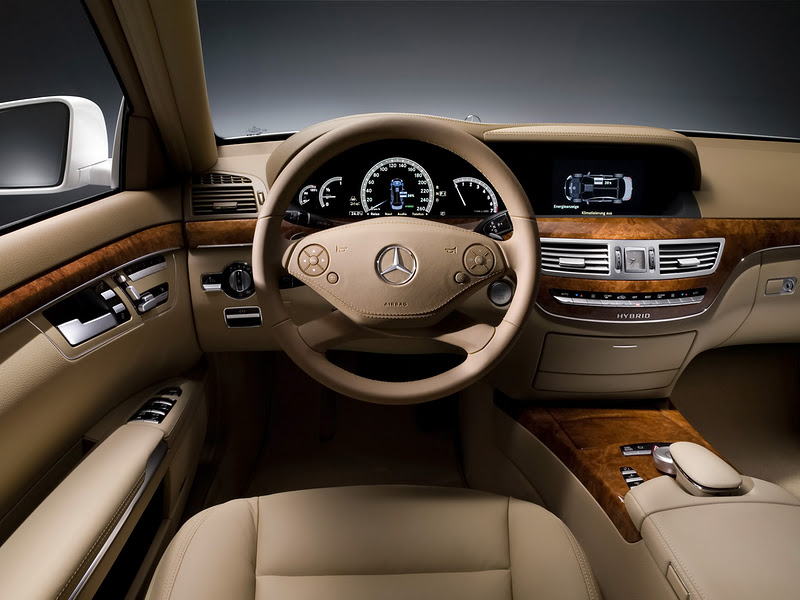
Mercedes-Benz also makes more use of light as a styling element in the interior. In future customers who specify the optional ambient lighting (standard for S400 Hybrid and S600) have a choice between three lighting moods: solar (amber), neutral (white) and polar (ice-blue).
The 2010 Mercedes-Benz S-Class will be in the showrooms of the premium manufacturer's own sales outlets and authorised dealers from June 2009, and can be ordered now.


Design by Free WordPress Themes | Bloggerized by Lasantha - Premium Blogger Themes | Skull Belt Buckles